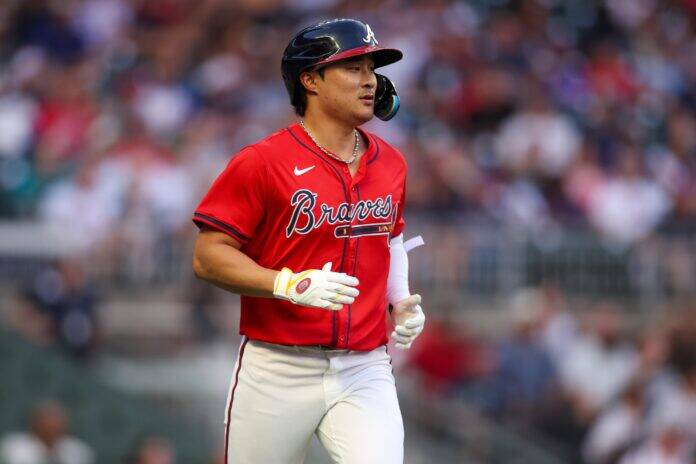
When the Braves reunited with Ha-Seong Kim earlier this offseason, they didn’t just fill their hole at shortstop for 2026; they unearthed a long-buried legacy and reconnected with a nearly forgotten chapter of franchise history.
Jung-Keun Bong: Atlanta’s Quiet Pioneer from Korea

Assuming Kim emerges from spring training healthy and ready, he’ll become the first South Korean-born player to make the Braves’ Opening Day roster in 23 years. The last to do so? Jung-Keun Bong, a name that today rings like a footnote to most fans, but whose brief major league tenure tells a much bigger story.
Before Kim was a rising KBO star turned MLB staple, before Shin-Soo Choo became a household name, and long before Hyun-jin Ryu became a Cy Young finalist, there was Bong, a teenage left-hander spotted by the Braves during an international tournament in Canada. The organization didn’t just see talent; they saw potential in a region of the world that, at the time, had produced just one major league player: Chan Ho Park.
With a $900,000 signing bonus and a promise that he’d finish high school, Bong joined the Braves system in 1997. By 2002, he was in the big leagues, albeit briefly, and in 2003, he cracked the Opening Day roster, becoming not just a Braves trivia answer, but a pioneer. Though his 5.05 ERA across 57 innings that season left much to be desired, Bong’s presence marked a quiet milestone: the arrival of South Korean baseball in Atlanta.
From Forgotten Call-Up to Cultural Connector
His MLB career was short-lived, a trade to Cincinnati, a few more starts, and then a decade-long career in Korea with the LG Twins, but Bong’s story never truly ended. It merely waited. Because the Braves never made a serious push for another Korean-born player, save for a brief flirtation with Ji-Hwan Bae (whose contract was voided), Bong remained the lone name on a very short list.
Now, that changes, and not with just any player. Ha-Seong Kim brings star power, proven success, and a growing legacy of his own. His time with the Padres turned heads across the league. His glove work, bat speed, and base running are all the product of a modern, globalized version of the game, one that Bong helped open the door to, even if only briefly and quietly.
Kim Carries the Torch, and the Braves Turn a Page
In some ways, Kim’s arrival is symbolic. It shows that the Braves, a team with deep roots and a rich past, are finally ready to re-engage with a talent pipeline they touched once and never truly explored again, until now.
He’s not just filling a position; he’s fulfilling a legacy.
And in doing so, he brings Bong’s name back into the conversation not as a forgotten call-up, but as a pioneer worth remembering.