
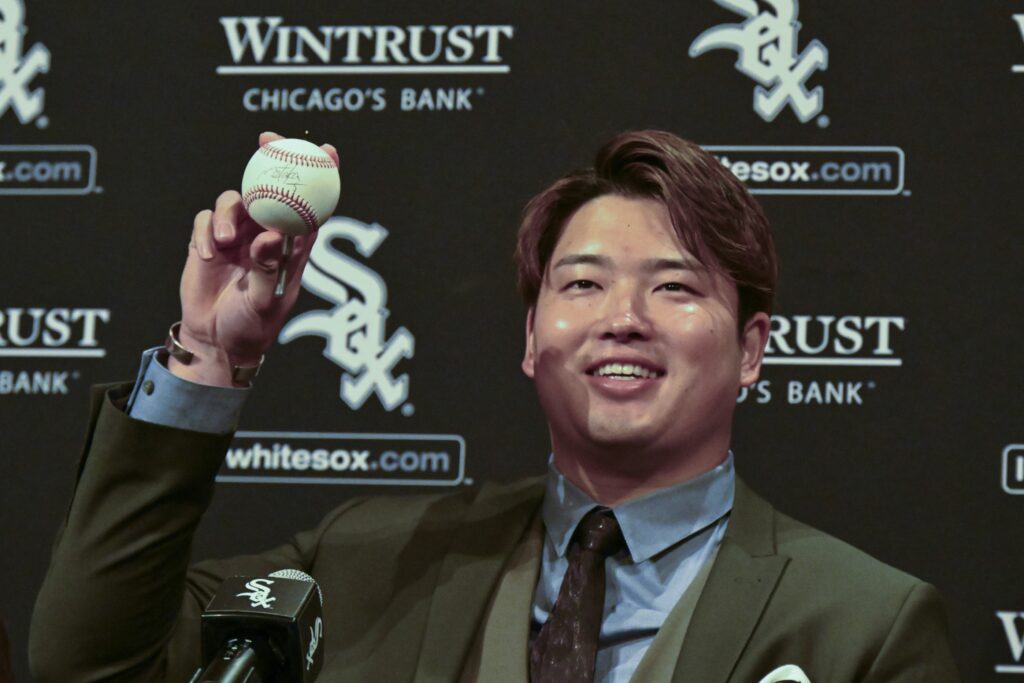
The Chicago White Sox entered this offseason with a level of urgency that had been missing in recent years, making aggressive moves to reshape both the roster and the franchise’s perception. The headline addition was Munetaka Murakami, a proven international slugger whose résumé immediately elevated expectations. That momentum, however, ran into an awkward but telling moment as spring training began.
Murakami shared a photo of his spring training locker on social media, revealing that his nameplate had misspelled his first name as “Munetaki” instead of “Munetaka.” The post, accompanied by a laughing emoji, made it clear the player himself was not offended. Even so, the image quickly circulated, reigniting familiar criticism of the White Sox as an organization that too often stumbles over details, especially at moments meant to showcase professionalism and renewal.
White Sox Make Small Mistake With Outsized Symbolism
In isolation, a misspelled nameplate is insignificant. These errors are easily corrected and quickly forgotten. In context, however, it carried symbolic weight. The White Sox have spent years battling a reputation for inconsistency and operational sloppiness, and moments like this tend to resonate far beyond their actual importance. For fans already skeptical, the mistake became shorthand for deeper frustrations, regardless of how trivial it truly was.
Murakami’s relaxed reaction softened the blow internally, but public perception rarely follows the player’s lead. High-profile acquisitions magnify every misstep, and this one arrived at the precise moment the organization hoped to present a clean slate.
The Request That Actually Mattered
Lost in the noise surrounding the typo was a more telling development from Murakami’s signing process. After agreeing to terms with the White Sox, Murakami made an unusual personal request, one that reflected his routine and comfort rather than marketing or prestige. The team agreed to accommodate it without hesitation. That decision spoke directly to how the organization intends to support its new cornerstone player.
Unlike a nameplate error, this accommodation reflects internal priorities and adaptability. It demonstrated an understanding that success with international stars often hinges on trust, communication, and respect for individual preparation habits.
Murakami’s Track Record Sets the Stakes
Murakami’s credentials justify the attention. He won Japan’s hitting Triple Crown in 2022, batting .318 with 56 home runs and 134 RBIs, establishing himself as one of the most dangerous hitters in the sport. Injuries limited him to 69 games in 2025, but even then, he produced a .286 average with 24 home runs and 52 RBIs, underscoring his efficiency and power.
As spring training continues, the misspelled nameplate will fade. What remains is the expectation that Murakami’s bat, not a clerical error, will define the White Sox’s offseason gamble.